 "Black Scruff"
Medium: Mixed Media
 "Po Bo"
Medium: Mixed Media
 "Joe Egg XOXO"
Medium: Mixed Media
 "Turn Around Eddie"
Medium: Mixed Media
 "Her Shoes Were Cemented On"
Medium: Mixed Media
 Dog standing on one leg
Medium: Mixed Media
 "Black Scruff""Po Bo""Joe Egg XOXO""Turn Around Eddie""Her Shoes Were Cemented On"Dog standing on one leg


"This (the First Image) is the largest work of art I've ever completed. It was done directly on the gallery wall. It took 12 hours and 38 minutes over several days. It was done with India ink washes and charcoal.
The concept was to create a public work inspired by the underworld. I like the idea of creating a drawing that could describe a place where life emerges from darkness and the mythological realms of Mother earth. It is a dark and mysterious place, with memories of our past and rivers of subconsciousness flowing like veins throughout its interior. The shapes and forms have no specific symbolism, although many are recognizable. They exist as life itself climbing into a luminous new world. The center is like a shaft of life beaming into the depths, separating one world from the other. (...)".
Tony Abeyta, 2008.
Heard Museum, Phoenix (Arizona).


Golden Cages
1998, oil on canvas

Like Fish
1998, oil on canvas, private collection

Sea Horse
1998, oil on canvas, Collection: Museum of Art of Fort Lauderdale, Florida
Humberto Castro was born in Havana, Cuba, in 1957. He graduated from the Academy of Fine Arts San Alejandro and Instituto Superior de Arte (ISA) in Havana.
He works in painting, drawing, printmaking, ceramics and installations. In his early years, he also delved into performance art, especially using it as a vehicle for social criticism in his country.
He is one of the most active members of the group widely recognized as the "Generation of the 80s"in Cuba, which generated changes in the aesthetic and conceptual art scene of the island.
In 1983 he founded the team Hexagon in which, alongside other artists, he mounted installations aimed at provoking public participation in the work. Between 1980 and 1984 he produces an extensive body of graphics, particularly innovating in the intaglio technique. He has designed sets for theater and film in Cuba.
In 1989 he emigrated to Paris, France, where he lived for ten years and became active in the Parisian intellectual scene, holding exhibitions and giving conferences across Europe. In 1999 he moved to the United States, where he lives and works.

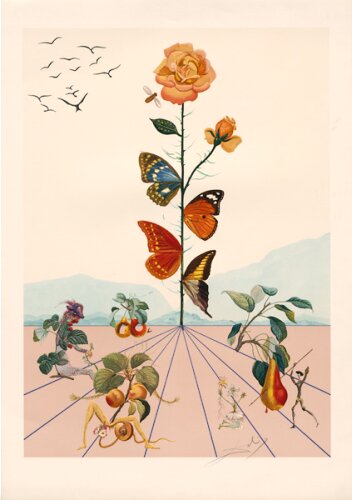
Salvador Domingo Felipe Jacinto Dalí i Domènech, Marquis of Dalí de Púbol (May 11, 1904 – January 23, 1989), commonly known as Salvador Dalí (Catalan pronunciation: [səɫβəˈðo dəˈɫi]), was a prominent Spanish Catalan surrealist painter born in Figueres.
Dalí was a skilled draftsman, best known for the striking and bizarre images in his surrealist work. His painterly skills are often attributed to the influence of Renaissance masters. His best-known work, The Persistence of Memory, was completed in 1931. Dalí's expansive artistic repertoire includes film, sculpture, and photography, in collaboration with a range of artists in a variety of media.

 Woman III, Willem de Kooning, $148.5 million: One of a series of six paintings completed between 1951 and 1953, de Kooning’s Woman III was formerly housed at the Tehran Museum of Contemporary Art until the 1979 revolution ruled it unacceptable. (Yikes.) Geffen acquired it in 1994 before selling it in 2006 to billionaire hedge-fund manager Steven A. Cohen.
 Portrait of Adele Bloch-Bauer I, Gustav Klimt, $144.8 million: Klimt’s most famous work (at least to college students) might be The Kiss, but it’s this one that brought the biggest cash prize. After bouncing around Austria and the U.S. for a while, the painting came into the possession of Maria Altmann, the niece of the woman in the painting. She sold it in June of 2006 to Ronald Lauder, and it now resides in New York’s Neue Galerie.
 Portrait of Dr. Gachet, Vincent van Gogh, $139 million: Van Gogh’s painting of the doctor who cared for him in his final months traded sellers before it was brought to the United States during World War II, when it was often loaned to the Metropolitan Museum of Art. In 1990, it was sold at Christie’s to Ryoei Saito, a Japanese business magnate. The painting went for more than $82 million at the time, making it the biggest art sale to date; adjusted over time, the figure’s almost $140 million.
 Bal du moulin de la Galette, Pierre-Auguste Renoir, $131.6 million: Yet another appearance by Ryoei Saito; the world of high-dollar art collecting is pretty small. Renoir’s impressionist masterpiece was owned by John Hay Whitney for years, but in May 1990, his widow sold the painting for $78 million (now $131 million). Ryoei Saito died in 1996, and the painting is now thought to be owned by a Swiss collector.
 Garcon a la pipe, Pablo Picasso, $119.9 million: This arresting image of a boy with a pipe was created in 1905, and originally bought by John Whitney in 1950 for $30,000. In May 2004, Whitney’s family foundation sold it via Sotheby’s to an undisclosed buyer that some said was Guido Barilla, owner of the Barilla Group.
 Nude, Green Leaves and Bust, Pablo Picasso, $106.5 million: Picasso’s 1932 work captures his mistress, Marie-Therese Walter, who also served as his muse. The large canvas — measuring 64 inches by 51 inches — belonged to Los Angeles art collectors Sidney and Frances Brody for 60 years, until Frances’ death in 2009. In May 2010, the painting was sold at Christie’s to an anonymous buyer over the telephone.
 Portrait of Joseph Roulin, Vincent van Gogh, $101.3 million: Part of a group of paintings of the Roulin family, this rendering of patriarch Joseph was sold from a private collection in Zurich to the Museum of Modern Art New York in 1989 for $58 million plus some other paintings. The current value of the sale is more than $100 million.
 Dora Maar au Chat, Pablo Picasso, $102.3 million: Picasso painted his lover, Dora Maar, many times over the course of their relationship, though this particular painting became the most revered and the most cherished by collectors. The sizable canvas (50.5 inches by 37.5 inches) was painted in 1941, when France was occupied by Nazis, and it then went to a pair of Chicago collectors. It changed hands and was eventually sold at Sotheby’s in 2006 to an anonymous Russian bidder who was likely Boris Ivanishvili. The $95 million sale is worth $102 million today.
 Irises, Vincent van Gogh, $101.6 million: Painted the year before he died, when he was living at an asylum, van Gogh’s Irises is a beautiful but simple rendering of a field of flowers. Its 1987 sale set a record, going for $53.9 million (about $101 million today), and after a brief period of private ownership, it was sold to Los Angeles’ J. Paul Getty Museum.
Posted by FIFTY24SF Gallery
Came across this a few weeks ago and really liked the work depicting Godzilla sized animals towering over the urban sprawl of Japan.


In her satirical and playful work, animal and human hybrids engage with each other and their environment, a familiar yet surreal world in which bird-headed women riding fish seem perfectly natural. Cheriel's works are meditations on the tedious dramas of her real-life Los Angeles social circle where boyfriend stealing friends, narcissistic hippies, do-gooders, and intellectuals are anthropomorphized into a surreal world of random theatre. Her paintings are the alchemy that transform pettiness into visual treasures.
“Cheriel's vibrant, gestural work beautifully juxtaposes humans, plants, and animals, connecting species figuratively and literally. Her pieces are whimsical, but profound in their ability to shift the viewer's perspective to value all life equally. Deedee's work demonstrates a powerful tension between the design elements of stripes, patterns, and color fields, with lyrical illustration. Deedee's work is idiosyncratic in the most ideal way... it is a reflection of her unique personality.”
- SHEPARD FAIREY
Referring to the magic of transforming societal ailments into beauty is the source for the title of the show, "Abracadabra" the incantation chosen by magicians and mystics to heal the seemingly incurable. The word was originally used by a Roman physician in the 2nd Century who prescribed disease sufferers to wear an amulet containing the word “Abracadabra” written in the form of a triangle. Combining elements from nature, urban landscapes, history, and pop culture, the paintings delve into the universal human need to find commonalities between ourselves and the world around us.
Using acrylic paint on wood and paper in a combination of textile-like patterns, delicate lines, haphazard drips, and fragile expressions, the artist transforms personal dramas into a commentary on humanity’s heroic quest for love and connection. In one painting a cult-like group of horse-headed women kneel before a bear-headed shaman who growls sharply in brightly colored patterns resembling native weaving. The horse-women, while cultish and beautiful, can also be seen as vain and unpredictable, as referenced in Chinese, Celtic, and Greco-Roman symbolism.
With influences (East Indian temple imagery, folk art, feminist punk rock, mysticism,
and the naturalistic environments of her Pacific Northwest childhood) derived from her diverse background, Cheriel’s work explores narratives that recognize the urgency and continuing conflict in our attempts to connect to the world and each other.


