

the top image is "Overload" it is watercolor on canvas and is 110" by 77"
the bottom image is "Girls Like Us" it is also watercolor of canvas and is 45" by 45"
http://www.conradruiz.com/


———————————————————————————————————
 |
A peapod boat sails away from a land made of bread and potatoes, over a sea of salmon
Picture: CARL WARNER
——————————————————————————————————-
| |

Coralscape: an underwater scene with coral made of broccoli, tropical fish made of various fruits and vegetables, and a pineapple island
Picture: CARL WARNER
——————————————————————————————————-
 |
Autumn Flakes: an autumnal landscape made enirely out of breakfast cereals
Picture: CARL WARNER
———————————————————————————————————————
 |
Bread and cheese: an edible landscape
Picture: CARL WARNER
—————————————————————————————————————-
 |
Parmesan cliffs with sweet potato boulders and cress and savoy cabbage foliage under a red cabbage sky
Picture: CARL WARNER
————————————————————————————————————————
 |
He spends a lot of time staring at vegetables in supermarkets, which can make him seem a little odd. However, finding the right shaped broccoli to use for a tree is an all-important task
Picture: CARL WARNER
—————————————————————————————————————-
 |
Fishscape: with rocks made of oyster shells and crab claws, boats made of marrows and asparagus, and a shining, slivery, slippery sea of fish
Picture: CARL WARNER
————————————————————————————————————————
 |
A landscape pr0duced for Sacla
Picture: CARL WARNER
—————————————————————————————————————————–
 |
Garlicshire: a village for lovers of garlic and cabbage
Picture: CARL WARNER

ROMANTIC TRIP NO.16
By Feng Zhengjie
Artwork Description
Dimensions: 109.5 by 109.5cm.; 42 3/4 by 42 3/4 in.
Medium: oil on canvas

ROMANTIC TRIP NO.10
By Feng Zhengjie
Artwork Description
Dimensions: 80x100 cm
Medium: Oil on canvas
Creation Date: 1997

ROMANTIC TRIP NO.13
By Feng Zhengjie
Artwork Description
Dimensions: 150 by 110cm. (alt: 59 by 43 3/8 in.)
Medium: oil on canvas

BRIDE AND BRIDEGROOM
By Feng Zhengjie
Artwork Description
Dimensions: 100×80cm
Medium: Oil on Canvas
Creation Date: 1997
http://www.saatchi-gallery.co.uk/artists/feng_zhengjie.htm

LE PAPILLON AMOUREUX
By Feng Zhengjie
Artwork Description
Dimensions: 73 3/4 by 74 7/8 in. 187 by 190.3 cm.
Medium: oil on canvas

LE PAPILLON AMOUREUX NO.14
By Feng Zhengjie
Artwork Description
Dimensions: 129.5 by 110cm.; 51 by 43 3/8 in.
Medium: oil on canvas
Feng Zhengjie (born 1968, Sichuan Province, China) is an artist based in Beijing. Originally a high-school and college art teacher in Sichuan, he came to Beijing in 1995.
His best-known work is his Portrait of China series, very large Warhol-style oil portraits, in a red/turquoise palette, of Chinese fashion model faces with vacant diverging eyes (his signature style). Critics view his work as a critique of contemporary consumer society. His early paintings were inspired by 1930s Shanghai posters. His more recent work is based on the red and green of traditional Chinese New Year art, the colours made "more acid, a representation of the flashy, commercial nature of modern China".
Zhengjie has exhibited internationally in many shows including Dialogue With Asia at Vika Gallery in Oslo, the 2002 Korea Contemporary Art Festival in Seoul, China Femmes de Chine at Veronique Maxe Gallery in Paris, Primary Colors at the Singapore Art Museum in Singapore and New Perspectives in Chinese Painting at Marella Gallery in Milan.
He is represented by Goedhuis Contemporary in London, New York and Beijing, and by Willem Kerseboom Gallery in Amsterdam.
http://www.saatchi-gallery.co.uk/artists/feng_zhengjie.htm
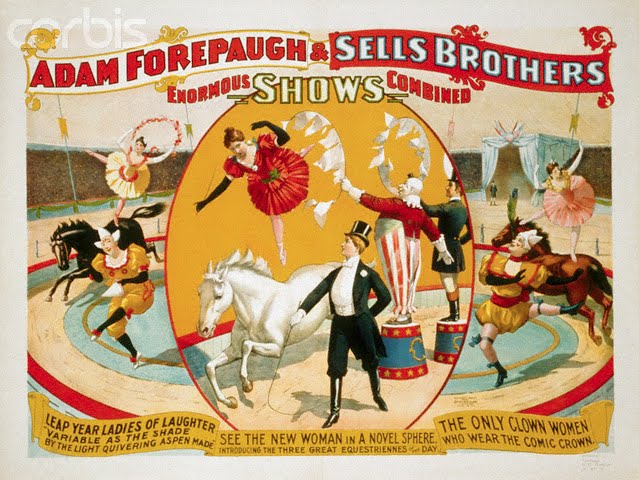 The Amazing American Circus Poster February 26, 2011 – July 10, 2011

| |
| Strobridge Lithographing Company Living Pair of Full Grown Hippopotomi. 1882 Color Lithograph Poster Gift of the Strobridge Lithographing Company, 1965.685:47 |

 This exhibition will travel to the Ringling Museum of Art in Sarasota, Florida. The Amazing American Circus Poster has been made possible in part by a major grant from the National Endowment for the Humanities: great ideas brought to life.


| The Colbert Report | Mon - Thurs 11:30pm / 10:30c | |||
| The Word - The Great White Wail | ||||
| ||||
 The photographer Nat Finkelstein, nicknamed “Nat the Hat”, was best known for his memorable chronicling of Andy Warhol’s Factory.
His photographs of Warhol and his exotic acolytes are almost as recognisable as the artist’s own works. They include celebrated shots of Warhol with Bob Dylan, of Edie Sedgwick chewing her necklace, of the Velvet Underground with the German model Nico, and more.
Nathaniel Finkelstein was born in Coney Island in 1933; his father was a New York cab driver. He graduated from the respected Stuyvesant High School, Brooklyn, in 1950. He had artistic aspirations but, being entirely unable to draw, was uncertain how to achieve them. Then, in 1952, he bought a camera and enrolled at the Brooklyn College to study photography. There, inspired by such great photographers as Edward Steichen, Finkelstein found his métier behind the lens. He also developed his militant political tendencies, to the extent that he was expelled during his final term after hurling a filing cabinet through a window while protesting at the college’s censorship of a racy college rag.
 All was not lost. Another of his tutors, the Russian émigré art director of Harper’s Bazaar, Alexey Brodovitch (who famously brought Cocteau, Chagall and Man Ray to illustrate the magazine), had taken a shine to the feisty Borough boy and gave him a placement assisting on fashion shoots. Eventually Finkelstein developed this into regular assignments as a photojournalist on Sports Illustrated. There he specialised in photographing the mundane — bridge tournaments, chess matches and dog shows — because, he said: “I was the only one who could make them visually compelling.”
By his early twenties Finkelstein was well on the way to establishing himself as a bona fide photographer. He was signed up by the PIX and Black Star agencies (the latter supplied Life magazine with much imagery) through which he met his idol, the war photojournalist Robert Capa, and he spent time with such famous photographers as Eugene Smith and Andreas Feininger.
Finkelstein also capitalised on his knack for being at the right place at the right time, specialising in spotting and recording the rich and varied subcultures of New York City, in particular the burgeoning Harlem jazz and soul scenes.
“I used to sell Ella Fitzgerald and Errol Garner weed,” he told an interviewer. “That was like a golden passport into that world.”
 In September 1962 Finkelstein got the break that would define his future. He was commissioned by Pageant magazine to do one of the first articles on Pop Art, entitled “What happens at a Happening?”. He found himself documenting a Claes Oldenburg “happening” in Greenwich Village.
 Two years later Finkelstein was at a party at Warhol’s Factory and met the artist along with his crowd of beautiful malcontents. He was unable to tear himself away, and he spent the next three years photographing all and sundry. He took the first photographs of the Velvet Underground (whom he nicknamed “the Psychopath’s Rolling Stones”); he shot Warhol with Marcel Duchamp; Salvador Dalí and Allen Ginsberg introduced him to Valerie Solanas, the radical feminist who shot and wounded Warhol with a handgun in 1968.
The relationship with the Factory suited both parties — Warhol enjoyed having a photographer to record his every nuance, and for Finkelstein there was no shortage of memorable subjects for his camera.
While diving in and out of the Factory, Finkelstein was also busy with other matters. A staunch political activist, he helped to co-ordinate civil rights rallies and anti-war demonstrations. This activity brought him into an association with the Black Panthers, for whom, according to his widow, Elizabeth, “he organised, trained and sourced munitions”.
As a consequence, in 1969 a judge issued a federal warrant for the arrest of Finkelstein in connection with an old drugs charge. Fearing for his life, he claimed, he fled the US and lived as a fugitive for the next dozen years. For some time he followed the hippy trail through the Middle East, selling hashish to make ends meet.
Eventually, the charges against him were dropped, and in 1982 Finkelstein returned to the US and its booming counterculture. He became involved in the New York punk music scene, briefly managing bands such as Khmer Rouge, and developed an addiction to cocaine, which prompted frequent visits to Bolivia to supply his needs more conveniently.
 It took the death of Warhol in 1987 to persuade Finkelstein that he needed to claw himself back from the brink of over-excess. He pulled himself together, dusted down his negatives and published his second book, Andy Warhol: The Factory Years, 1964-1967. An exhibition at the V&A followed and prompted him, at the age of 56, to pick up his camera in earnest.
H e moved first to London — where, in baseball cap, bomber jacket and sneakers, he was a constant presence on the rave scene — then to Amsterdam and back to New York, where he shot a generation of New York club kids for his book Merry Monsters (1993). Finkelstein now found himself in demand, travelling and exhibiting his work worldwide. He had more than 75 solo and group shows at museums and galleries, including Tate Modern, the V&A, the Whitney and the Metropolitan Museum of Art in New York, and the Pompidou Centre in Paris. His photographs appeared in such magazines as Life, Time, Sports Illustrated, Harper’s & Queen, Vogue, The New York Times Magazine and the British broadsheets.
There is a retrospective exhibition of his work at the Idea Generation Gallery, London, from December, and his work will also feature in the exhibition Who Shot Rock at the Brooklyn Museum, New York, from the end of this month. 
In his last years Finkelstein moved from his beloved Brooklyn to Shandaken in upstate New York to finish writing his memoirs, entitled The 14 Ounce Pound.
Finkelstein was married five times. He is survived by his wife Elizabeth.
Nat Finkelstein, photographer, was born on January 17, 1933. He died from complications of pneumonia and emphysema on October 2, 2009, aged 76
From October 17, 2009


Sanrio’s mobile pop-up tour launched this month in San Francisco, with fans dismissing stormy weather to shop the special 50th Anniversary items and meet-and-greet with iconic characters like Hello Kitty and others interacting and mingling together for the first time in Sanrio character history. Special items can be seen here.
Sanrio mobile pop-up tour can be found next in these cities:
Thurs 10.28 Portland/Pioneer Courthouse Square
Sat 10.30–Sun 10.31 Seattle/Seattle Center
Thurs 11.04 Sacramento/Westfield Downtown Plaza
Sat 11.06 San Diego/University Town Center
Sun 11.07 Tustin/District at Tustin Legacy
Thurs 11.11 LA/Small Gift LA event
Sat 11.13–Sun 11.14 Las Vegas/Town Square Center
Tues 11.16 Tempe/Mill Avenue
Fri 11.19 Austin/location TBD
Sun 11.21 New Orleans/Riverwalk
Sat 11.26–Mon 11.28 Atlanta/Atlantic Station
Thurs 12.02–Sun 12.05 Miami/Small Gift Miami event
Fri 12.10 NYC / location TBD


